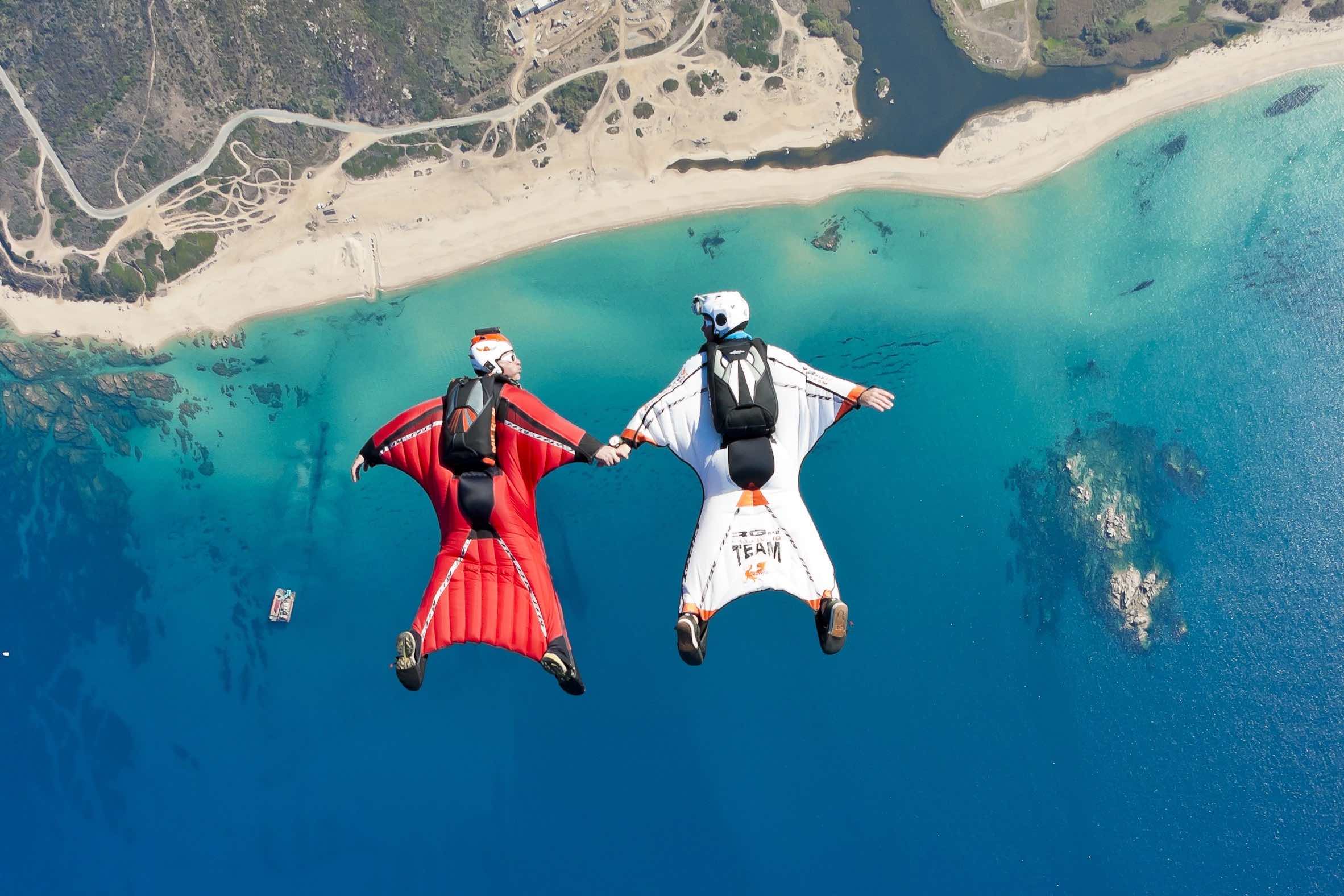
I had wanted, for a long time, to write something about the new reflections I’ve had in recent years on my outlook on life and values, but my thoughts were too tangled and I never knew where to begin. Then, perhaps because of a sudden flash of inspiration, I first came up with a very fitting title for this piece—and finally found a reason to start writing.
Isn't that beautiful—this line comes from the final scene of the film Point Break: in a raging storm far off the coastline, the protagonist Utah roars, trying to persuade the antagonist Bodhi to give up on challenging a massive wave that is certain death, but Bodhi simply roars back with this line as his response, then turns away—never to return... Although, sitting in the cinema back then, I didn’t yet have much understanding of the line, it still etched itself deep into my mind, all the way to today.
What kind of beauty can there be in this world that would be worth someone giving their life for?
Over the past few years, as I’ve learned more and more about various outdoor extreme sports, I’ve gradually begun to understand the distinctive view of life held by these real-world “madmen.” From the moment a life is born, it is already on a path toward death; this is an unavoidable law of nature. And for a person with self-awareness, what matters is not how one will die, but what kind of way one chooses to live. On the premise of not harming others, people have the right to choose their way of life—whether it is pursuing career success, staying close to family in peace, or devoting life to exploration and adventure. These are simply different choices; there is no inherent good or bad. As long as you can find something that is profoundly meaningful to you—so meaningful that it outweighs life itself—and pursue it with resolve, then you will not have lived in vain.
In fact, “not harming others” is a somewhat tricky notion. How do we define harm? If someone is injured or even dies in the course of an adventure, and their family grieves and suffers for it, does that, in some sense, count as harming others? In my view, thinking along these lines ultimately falls into a highly subjective, idealist dead end. But one thing we can sort out is this: it is clearly impossible to live in the world in a way that satisfies everyone. Today, if you give up an adventure you’ve long looked forward to in order to reassure your family, then tomorrow, must you give up a relationship you’ve cultivated for years to keep them satisfied? Must you give up your career development in a big city in order to be with them? On questions like these, different self-awareness and life experiences lead people to see things differently, and therefore to arrive at different answers. As a result, what counts as “not harming others,” and what trade-offs let you live with a clear conscience, cannot fundamentally be measured on an objective scale. From the perspective of human society as a whole, as long as harm is not caused by subjective malice toward others, that probably counts as the minimum standard for “not harming others.”
Many people feel that extreme ways of playing outdoor sports—such as backcountry steep-skiing, cave diving, and wingsuit flying—contain far too many uncontrollable risks, and that spending one’s energy pursuing them is a waste of life. But we can think about it from another angle. Accidents in life are inevitable: crime, illness, traffic accidents, and countless other causes claim innumerable lives every year, and no one can guarantee they will not become one of them. If, before engaging in these risk-laden activities, a person has done every preparation they should, yet still encounters a low-probability accident beyond human control—then dying for something they truly love is not an unacceptable ending. By comparison, an accident like getting hit by a car on the way out is even more painful and harder to accept.
The dimension of life is not reflected only in its length. Imagine that when you are old and nearing death, looking back on your long life—how would you feel? What unfinished wishes and regrets would you have? But what if, from this moment on, you had only one year left? One day? One hour? Would what you want to do be any different?
My answer is: standing at the end of life and looking back, I would hope I had lived a happy, exciting, and fulfilling life, with no regrets.
I would hope to have seen the world’s countless landscapes, to pursue the happiness I want with freedom, to draw strength from family, friendship, and love without being bound by them. I would hope to find someone I truly love, and who truly loves me as well—though that is not entirely up to me, and can only be left to fate. I would hope to become someone valuable to society and to others. I hope my existence can bring a positive influence to those I care about and who care about me, and also bring me a sense of affirmation of my own value.
I can no longer remember where I first saw this line, but I have always used it to remind myself how I should plan my life:
Some people die at 25, but aren't buried until 75.
-- Benjamin Franklin
Therefore, I hope that in every minute and every second of my life, I can clearly and genuinely feel that I am alive.
I'll make every second count.
I once had a realization: at their core, there are only two kinds of things that can bring people a steady, ongoing sense of happiness—exploration and creation. Learning perhaps counts as half of one as well, but it is more like groundwork for the first two: by constantly learning and honing your skills, you can explore more freely and create more at will.
In skiing, the reason backcountry freeride sits at the “top of the pecking order” of the sport, I think, is that it is a perfect fusion of honing one’s abilities and exploring the unknown world. On a pure stage far from civilization, there are no spectators and no cheers; there is only the awe and reverence of a tiny mortal confronting the mighty power of nature. When you carry skills tempered by years, climb to the summit, look out over that expanse of bright white before you, and listen to the gale howl past your ears, I think that even the most battered and despondent soul will, in that moment, be moved to exclaim... Isn't that beautiful?
By contrast, those styles that turn into acrobatics on snow do not really bring genuine happiness. They merely satisfy, to some extent, a sense of achievement and self-identity. Some friends strongly dislike comparing freestyle with acrobatics, but whether in difficulty of maneuvers or the risks involved, acrobatic acts far exceed those snow tricks. Stunt performers also train from childhood; perhaps only athletes at the xgames level are even qualified to be mentioned in the same breath. So this inexplicable sense of superiority has no basis.
I have discussed this view with different friends. One older friend later angrily called me out in a WeChat Moments comment thread. I don’t dislike such bluntness, but this kind of emotional outburst that lacks deeper reasoning is not constructive either, nor does it make anyone feel pleasant. Another friend offered a different thought: he believed acrobatics are unappealing because, in daily life, we don’t treat those stunt movements as entertainment; but when skiing, it’s easy to watch and be exposed to freestyle, which breeds admiration and leads people to train hard, hoping that one day they can reach the level of the experts. In my view, most people’s mindset here is essentially still treating skiing as a social game—pursuing goals and others’ recognition, rather than happiness itself. Imagine if the park were built in a remote corner of the resort, with no one watching or cheering—how many people would still have the motivation to train? It is also easy to give a counterexample for reflection: many surfers practice balance boards at home. Their audience is not comparable to skiing, but it is not small either. Professional acrobats can easily stand on three stacked balance boards and perform moves like tossing and catching balls over their heads, yet I have never seen any surfer aspire to and practice that—because it neither attracts attention nor brings real happiness.
Last winter, it took me some effort to truly understand these points. At the time, I realized I had become somewhat overly obsessed with skiing: whether conditions were good or bad, I kept going up the mountain; when others trained tricks, I trained too; even if I didn’t actually like those things, seeing others land them would still affect my mindset. I even felt anxious simply because I hadn’t skied every best powder run. The psychologist’s advice was to let go of the meaningless utilitarian mindset attached to these leisure activities, and to do some purely altruistic activities—like volunteering—which would help calm my mind and ease anxiety. So I began taking less skilled friends to casually cruise the mountain and sightsee. Although I often had to stop and wait, skied less than before, and couldn’t really learn any new skills, I did indeed feel a long-lost sense of fulfillment and calm in the process of helping others.
After some reflection, I came to realize that if it is only about pleasing yourself, then it is best to do things that purely bring you happiness—so the happiness you get is also pure. If you want to pursue the happiness that comes from achieving goals, then you should direct that drive toward things that can help others more—such as work, a career, or public-interest activities. Pursuing that kind of sense of accomplishment is more valuable, both for yourself and for the people around you.
As I write, I realize the theme has drifted a bit. It’s about time to force it back and wrap up.
I still remember that winter many years ago, when I met a few friends traveling around the world by Lake Baikal. It brought a huge shock to my outlook on life. At that time, I was trapped in the 996 life of a big city, trying to find the joy of creation through work. Yet, night after night, taking a taxi home after getting off work late, walking through my residential compound, I would breathe in the smog while thinking about the meaning of life: even though what I did was both interesting and challenging, was it really worth sacrificing almost all of my life for it? That trip made me, for the first time, want to step outside my original circle of life—there is such a big world out there; why not see more of it while I’m still young?
It was also on the trip to Australia that same year. On the Great Barrier Reef, I could only snorkel, and I watched enviously as other tourists on the same boat put on scuba gear and descended into the deep sea. I began to realize that the meaning of travel is not only about checking off many countries and meeting many different people, but even more about what you can do on the journey and what different landscapes you can experience. So, in these years constrained by the pandemic, I made up my mind to get into technical diving, signed up for a pilot license, overcame my fear of heights and started skydiving to log jumps, and spent every winter in the snow mountains... I invested a great deal of time, energy, and money into the goal of filling out my personal skill tree, hoping that when the world fully reopens, my travels will no longer be left with regrets.
If you think about it, even though life is long, the years when you are healthy and energetic, without too much financial pressure or family burdens, are truly limited—and therefore exceptionally precious. No matter what path one ultimately chooses, I have always felt that one should cherish these few young years, explore all kinds of corners of the world, experience the collisions between different cultures and ideas, and, most importantly, pursue those strange and magnificent alternative landscapes in this world.
That way, when faced with all kinds of negative emotions along the long road of life—hesitation, disappointment, frustration, dejection—there will always be something to hold onto: recalling the crisp birdsong in mountain pine forests shrouded in morning mist; the squeaking sound of skis pressing through soft powder sprinkled with broken sunlight; the bubbling sound of exhaled air while staring Nemo in the eyes underwater; and the wind roaring past your ears as you leap out of the aircraft with the earth rushing up to meet you... Thinking back on those vivid sounds and scenes you have experienced, and then looking ahead at the vast world full of unknown possibilities, take a deep breath and ask yourself—Isn't that beautiful?