Preface
Working in an operations department, running load tests is an indispensable part of day-to-day work. So by reading the source code of the WebBench project, I did a quick pass to understand the basic principles of stress-testing tools and recorded some notes here.
The cleaned-up source code can be downloaded here. It includes a correct CMake file and some appropriate changes, so it can be compiled with CLion on Windows; it should also work on Linux.
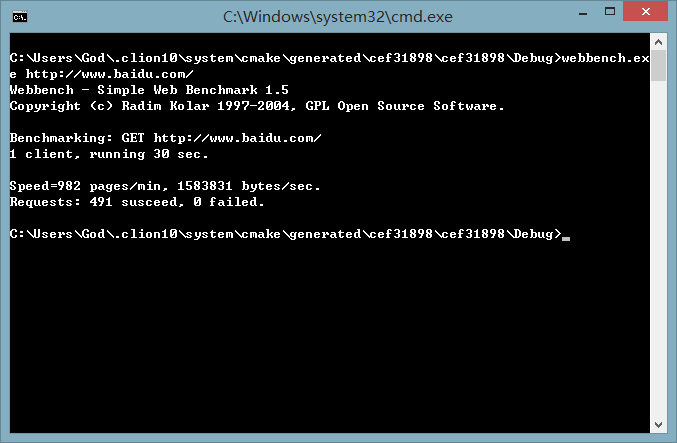
The actual runtime effect on Windows is as follows:
Source Code Walkthrough
socket.c
/* $Id: socket.c 1.1 1995/01/01 07:11:14 cthuang Exp $
 *
 * This module has been modified by Radim Kolar for OS/2 emx
 */

/***********************************************************************
  module:       socket.c
  program:      popclient
  SCCS ID:      @(#)socket.c    1.5  4/1/94
  programmer:   Virginia Tech Computing Center
  compiler:     DEC RISC C compiler (Ultrix 4.1)
  environment:  DEC Ultrix 4.3
  description:  UNIX sockets code.
 ***********************************************************************/

#include <sys/types.h>
#include <sys/socket.h>
#include <fcntl.h>
#include <netinet/in.h>
#include <arpa/inet.h>
#include <netdb.h>
#include <sys/time.h>
#include <string.h>
#include <unistd.h>
#include <stdio.h>
#include <stdlib.h>
#include <stdarg.h>

// In simple terms, this function connects based on the target address and port, and returns a socket.
int Socket(const char *host, int clientPort) {
    int sock;
    unsigned long inaddr;
    struct sockaddr_in ad;
    struct hostent *hp;

    memset(&ad, 0, sizeof(ad));
    ad.sin_family = AF_INET;

    // First, convert a dotted-decimal IP address into an integer.
    inaddr = inet_addr(host);
    if (inaddr != INADDR_NONE)
        memcpy(&ad.sin_addr, &inaddr, sizeof(inaddr));
    else {
        // If conversion fails, it indicates a domain name, so call gethostbyname() for DNS resolution.
        hp = gethostbyname(host);
        if (hp == NULL)
            return -1;
        memcpy(&ad.sin_addr, hp->h_addr, hp->h_length);
    }
    ad.sin_port = htons(clientPort);

    // Create a socket and initiate the connection.
    sock = socket(AF_INET, SOCK_STREAM, 0);
    if (sock < 0)
        return sock;
    if (connect(sock, (struct sockaddr *) &ad, sizeof(ad)) < 0)
        return -1;
    return sock;
}
webbench.c
/*
 * (C) Radim Kolar 1997-2004
 * This is free software, see GNU Public License version 2 for
 * details.
 *
 * Simple forking WWW Server benchmark:
 *
 * Usage:
 *   webbench --help
 *
 * Return codes:
 *    0 - sucess
 *    1 - benchmark failed (server is not on-line)
 *    2 - bad param
 *    3 - internal error, fork failed
 *
 */
#include "socket.c"
#include <unistd.h>
#include <sys/param.h>
#include <getopt.h>
#include <strings.h>
#include <time.h>
#include <signal.h>

/* values */
// The volatile keyword declares this variable as volatile; for consistency it should be stored in memory.
volatile int timerexpired = 0;
int speed = 0;
int failed = 0;
int bytes = 0;
// HTTP protocol version
/* globals */
int http10 = 1; /* 0 - http/0.9, 1 - http/1.0, 2 - http/1.1 */
// Define the HTTP methods allowed by the program here.
/* Allow: GET, HEAD, OPTIONS, TRACE */
#define METHOD_GET 0
#define METHOD_HEAD 1
#define METHOD_OPTIONS 2
#define METHOD_TRACE 3
#define PROGRAM_VERSION "1.5"
int method = METHOD_GET;
// Number of concurrent clients
int clients = 1;
int force = 0;
int force_reload = 0;
// Proxy server address and port
int proxyport = 80;
char *proxyhost = NULL;
int benchtime = 30;
/* internal */
int mypipe[2];
char host[MAXHOSTNAMELEN];
#define REQUEST_SIZE 2048
// This string stores the HTTP request content.
char request[REQUEST_SIZE];

/*
 *  To use getopt_long(), we first need to determine two structures:
    1. A string including the required short option characters; if an option takes an argument, add a ":" after the character.
    2. A struct array containing long option strings. Each struct contains 4 fields:
       the first is the long option string; the second is a flag which can only be 0, 1, or 2, meaning respectively no option, has option, option is optional;
       the third is always NULL; the fourth is the corresponding short option character.
       The last element of the struct array is all NULL and 0, marking the end.
 */
static const struct option long_options[] =
        {
                {"force",   no_argument, &force,        1},
                {"reload",  no_argument, &force_reload, 1},
                {"time",    required_argument, NULL,    't'},
                {"help",    no_argument,       NULL,    '?'},
                {"http09",  no_argument,       NULL,    '9'},
                {"http10",  no_argument,       NULL,    '1'},
                {"http11",  no_argument,       NULL,    '2'},
                {"get",     no_argument, &method, METHOD_GET},
                {"head",    no_argument, &method, METHOD_HEAD},
                {"options", no_argument, &method, METHOD_OPTIONS},
                {"trace",   no_argument, &method, METHOD_TRACE},
                {"version", no_argument,       NULL,    'V'},
                {"proxy",   required_argument, NULL,    'p'},
                {"clients", required_argument, NULL,    'c'},
                {NULL, 0,                      NULL,    0}
        };

/* prototypes */
static void benchcore(const char *host, const int port, const char *request);

static int bench(void);

static void build_request(const char *url);

// This is a signal handler.
// If an alarm signal occurs, set the timeout flag to 1.
// The request loop stops issuing new requests when it detects this flag.
static void alarm_handler(int signal) {
    timerexpired = 1;
}

// Print help information to standard output.
static void usage(void) {
    fprintf(stderr,
            "webbench [option]... URL\n"
                    "  -f|--force               Don't wait for reply from server.\n"
                    "  -r|--reload              Send reload request - Pragma: no-cache.\n"
                    "  -t|--time <sec>          Run benchmark for <sec> seconds. Default 30.\n"
                    "  -p|--proxy <server:port> Use proxy server for request.\n"
                    "  -c|--clients <n>         Run <n> HTTP clients at once. Default one.\n"
                    "  -9|--http09              Use HTTP/0.9 style requests.\n"
                    "  -1|--http10              Use HTTP/1.0 protocol.\n"
                    "  -2|--http11              Use HTTP/1.1 protocol.\n"
                    "  --get                    Use GET request method.\n"
                    "  --head                   Use HEAD request method.\n"
                    "  --options                Use OPTIONS request method.\n"
                    "  --trace                  Use TRACE request method.\n"
                    "  -?|-h|--help             This information.\n"
                    "  -V|--version             Display program version.\n"
    );
};

int main(int argc, char *argv[]) {
    int opt = 0;
    int options_index = 0;
    char *tmp = NULL;

    // If called without extra arguments, print help and exit.
    if (argc == 1) {
        usage();
        return 2;
    }

    // Use getopt_long() to parse command-line options.
    // Each call parses one option; when parsing finishes, it returns EOF.
    while ((opt = getopt_long(argc, argv, "912Vfrt:p:c:?h", long_options, &options_index)) != EOF) {
        switch (opt) {
            case  0 :
                break;
            case 'f':
                force = 1;
                break;
            case 'r':
                force_reload = 1;
                break;
            case '9':
                http10 = 0;
                break;
            case '1':
                http10 = 1;
                break;
            case '2':
                http10 = 2;
                break;
            case 'V':
                printf(PROGRAM_VERSION"\n");
                exit(0);
            case 't':
                benchtime = atoi(optarg);
                break;
            case 'p':
                /* proxy server parsing server:port */
                // optarg is a string pointer, pointing to the parsed argument.
                tmp = strrchr(optarg, ':');
                proxyhost = optarg;
                if (tmp == NULL) {
                    break;
                }
                // Validate the proxy server argument here.
                if (tmp == optarg) {
                    fprintf(stderr, "Error in option --proxy %s: Missing hostname.\n", optarg);
                    return 2;
                }
                if (tmp == optarg + strlen(optarg) - 1) {
                    fprintf(stderr, "Error in option --proxy %s Port number is missing.\n", optarg);
                    return 2;
                }
                // If OK, set the proxy server port and address here.
                *tmp = '\0';
                proxyport = atoi(tmp + 1);
                break;
            case ':':
            case 'h':
            case '?':
                usage();
                return 2;
                break;
            case 'c':
                // Set how many concurrent clients.
                clients = atoi(optarg);
                break;
        }
    }
// If there are no more option characters, getopt() returns -1.
// Then optind is the index in argv of the first argv-element that is not an option.
// This means optind points to the first element in argv that is not an option; normally it should point to the URL.
// If optind points outside argv, it means no URL was provided, so report a missing-argument error.
if (optind == argc) {
fprintf(stderr, "webbench: Missing URL!\n");
usage();
return 2;
}
    // Handle invalid parameters and reset to correct values.
    if (clients == 0) clients = 1;
    if (benchtime == 0) benchtime = 60;
    /* Copyright */
    fprintf(stderr, "Webbench - Simple Web Benchmark "PROGRAM_VERSION"\n"
            "Copyright (c) Radim Kolar 1997-2004, GPL Open Source Software.\n"
    );
    // In the normal case, optind should point to the position of the URL string in argv, i.e., the last element.
    // Build the request content based on this URL.
    build_request(argv[optind]);
    /* print bench info */
    // The following prints benchmark-related information,
    // such as the request type, URL, protocol version, number of clients, etc.
    printf("\nBenchmarking: ");
    switch (method) {
        case METHOD_GET:
        default:
            printf("GET");
            break;
        case METHOD_OPTIONS:
            printf("OPTIONS");
            break;
        case METHOD_HEAD:
            printf("HEAD");
            break;
        case METHOD_TRACE:
            printf("TRACE");
            break;
    }
    printf(" %s", argv[optind]);
    switch (http10) {
        case 0:
            printf(" (using HTTP/0.9)");
            break;
        case 2:
            printf(" (using HTTP/1.1)");
            break;
    }
    printf("\n");
    if (clients == 1) printf("1 client");
    else
        printf("%d clients", clients);

    // Print more information based on various parameters.
    printf(", running %d sec", benchtime);
    if (force) printf(", early socket close");
    if (proxyhost != NULL) printf(", via proxy server %s:%d", proxyhost, proxyport);
    if (force_reload) printf(", forcing reload");
    printf(".\n");

    // Finally, start the test. The request has been built and stored in the request string.
    return bench();
}

// This function builds the request content and stores it into the global request char array.
void build_request(const char *url) {
    char tmp[10];
    int i;

    // Zero out the first n bytes of memory (string).
    bzero(host, MAXHOSTNAMELEN);
    bzero(request, REQUEST_SIZE);

    // Validate parameters and reset them to a legal state.
    if (force_reload && proxyhost != NULL && http10 < 1) http10 = 1;
    if (method == METHOD_HEAD && http10 < 1) http10 = 1;
    if (method == METHOD_OPTIONS && http10 < 2) http10 = 2;
    if (method == METHOD_TRACE && http10 < 2) http10 = 2;

    // Build the request based on the method; overall this is a bunch of string operations.
    switch (method) {
        default:
        case METHOD_GET:
            strcpy(request, "GET");
            break;
        case METHOD_HEAD:
            strcpy(request, "HEAD");
            break;
        case METHOD_OPTIONS:
            strcpy(request, "OPTIONS");
            break;
        case METHOD_TRACE:
            strcpy(request, "TRACE");
            break;
    }

    strcat(request, " ");

    // Validate the URL.
    // It must include the protocol name.
    if (NULL == strstr(url, "://")) {
        fprintf(stderr, "\n%s: is not a valid URL.\n", url);
        exit(2);
    }
    // It cannot be too long.
    if (strlen(url) > 1500) {
        fprintf(stderr, "URL is too long.\n");
        exit(2);
    }
    // Without a proxy server, the protocol must be HTTP.
    if (proxyhost == NULL) if (0 != strncasecmp("http://", url, 7)) {
        fprintf(stderr, "\nOnly HTTP protocol is directly supported, set --proxy for others.\n");
        exit(2);
    }
    /* protocol/host delimiter */
    // Find the start position of the actual URL content after stripping the *:// prefix.
    i = strstr(url, "://") - url + 3;
    /* printf("%d\n",i); */

    // Check whether the URL ends with '/'.
    if (strchr(url + i, '/') == NULL) {
        fprintf(stderr, "\nInvalid URL syntax - hostname don't ends with '/'.\n");
        exit(2);
    }
    if (proxyhost == NULL) {
        // If not using a proxy, extract the hostname as the target address for sending the request.
        // First, check whether the URL contains a port number.
        if (index(url + i, ':') != NULL &&
            index(url + i, ':') < index(url + i, '/')) {
            // If a port is included, separate the hostname and port; extract the hostname first.
            strncpy(host, url + i, strchr(url + i, ':') - url - i);
            // Then manually parse out the port string, convert it to an integer, and store it.
            bzero(tmp, 10);
            strncpy(tmp, index(url + i, ':') + 1, strchr(url + i, '/') - index(url + i, ':') - 1);
            /* printf("tmp=%s\n",tmp); */
            proxyport = atoi(tmp);
            if (proxyport == 0) proxyport = 80;
        } else {
            // Otherwise, just extract the hostname.
            // strcspn() returns the length of the string before certain characters.
            // Here, it is the number of characters before '/'.
            strncpy(host, url + i, strcspn(url + i, "/"));
        }
        // Finally, attach the request path.
        // printf("Host=%s\n",host);
        strcat(request + strlen(request), url + i + strcspn(url + i, "/"));
    } else {
        // If using a proxy, there's no need to care about the hostname, because the destination will be the proxy.
        // In that case, just paste the URL into the request; the proxy will send the request to that address.
        // printf("ProxyHost=%s\nProxyPort=%d\n",proxyhost,proxyport);
        strcat(request, url);
    }
    // Protocol version
    if (http10 == 1)
        strcat(request, " HTTP/1.0");
    else if (http10 == 2)
        strcat(request, " HTTP/1.1");
    strcat(request, "\r\n");

    // Add UA.
    if (http10 > 0)
        strcat(request, "User-Agent: WebBench "PROGRAM_VERSION"\r\n");

    // If not using a proxy, also include the Host header.
    if (proxyhost == NULL && http10 > 0) {
        strcat(request, "Host: ");
        strcat(request, host);
        strcat(request, "\r\n");
    }

    // And a few other HTTP headers.
    // From this header handling we can see that sometimes options are not always handled exactly the way you expect.
    // For example, this program adjusts various options in code to comply with rules.
    if (force_reload && proxyhost != NULL) {
        strcat(request, "Pragma: no-cache\r\n");
    }
    if (http10 > 1)
        strcat(request, "Connection: close\r\n");
    /* Finally, add an empty line to end the request. */
    if (http10 > 0) strcat(request, "\r\n");
    // printf("Req=%s\n",request);
}

/* vraci system rc error kod */
// This function is responsible for a series of preparations before issuing requests.
static int bench(void) {
    int i, j, k;
    pid_t pid = 0;
    FILE *f;

    /* check avaibility of target server */
    // Create a socket connection to the target server to check whether it can connect normally.
    i = Socket(proxyhost == NULL ? host : proxyhost, proxyport);
    if (i < 0) {
        fprintf(stderr, "\nConnect to server failed. Aborting benchmark.\n");
        return 1;
    }
    close(i);
    /* create pipe */
    // Then create a pipe for communicating with child processes.
    if (pipe(mypipe)) {
        perror("pipe failed.");
        return 3;
    }

    /* not needed, since we have alarm() in childrens */
    /* wait 4 next system clock tick */
    /*
    cas=time(NULL);
    while(time(NULL)==cas)
          sched_yield();
    */

    /* fork childs */
    // Create child processes according to the preset number of clients.
    for (i = 0; i < clients; i++) {
        pid = fork();
        // If this is a child process or an error occurred, exit the loop.
        if (pid <= (pid_t) 0) {
            /* child process or error*/
            sleep(1); /* make childs faster */
            break;
        }
    }

    // If fork() fails, report and exit.
    if (pid < (pid_t) 0) {
        fprintf(stderr, "problems forking worker no. %d\n", i);
        perror("fork failed.");
        return 3;
    }

    // For child processes, have them call the benchmark function to run the test.
    if (pid == (pid_t) 0) {
        /* I am a child */

        // Depending on whether a proxy is used, send the request to different hostnames.
        if (proxyhost == NULL)
            benchcore(host, proxyport, request);
        else
            benchcore(proxyhost, proxyport, request);

        // fdopen() converts a file descriptor into FILE *, allowing use of standard library functions.
        f = fdopen(mypipe[1], "w");
        // If opening fails, still report and exit.
        // It would be better to define the error codes for readability.
        if (f == NULL) {
            perror("open pipe for writing failed.");
            return 3;
        }
        /* fprintf(stderr,"Child - %d %d\n",speed,failed); */
        // Write the test results into the pipe for the parent process to read.
        fprintf(f, "%d %d %d\n", speed, failed, bytes);
        fclose(f);
        return 0;
    } else {
        // The parent process reads the results returned by the child processes.
        // The pattern here is that multiple child processes write to the same pipe, then the parent reads them.
        f = fdopen(mypipe[0], "r");
        if (f == NULL) {
            perror("open pipe for reading failed.");
            return 3;
        }
        // Disable buffering for this stream
        // to avoid waiting during reads below.
        setvbuf(f, NULL, _IONBF, 0);
        speed = 0;
        failed = 0;
        bytes = 0;

        // Start looping to read results returned by child processes.
        while (1) {
            pid = fscanf(f, "%d %d %d", &i, &j, &k);
            if (pid < 2) {
                fprintf(stderr, "Some of our childrens died.\n");
                break;
            }
            speed += i;
            failed += j;
            bytes += k;
            /* fprintf(stderr,"*Knock* %d %d read=%d\n",speed,failed,pid); */
            // If the number of reads matches the number of child processes, exit the loop.
            if (--clients == 0) break;
        }
        fclose(f);
        // Finally, print the aggregated results.
        printf("\nSpeed=%d pages/min, %d bytes/sec.\nRequests: %d susceed, %d failed.\n",
               (int) ((speed + failed) / (benchtime / 60.0f)),
               (int) (bytes / (float) benchtime),
               speed,
               failed);
    }
    return i;
}

// This is the core function responsible for issuing requests.
void benchcore(const char *host, const int port, const char *req) {
    int rlen;
    char buf[1500];
    int s, i;
    struct sigaction sa;

    /* setup alarm signal handler */
    // Add a signal handler here so that we can stop the benchmark via a timer signal.
    sa.sa_handler = alarm_handler;
    sa.sa_flags = 0;
    if (sigaction(SIGALRM, &sa, NULL))
        exit(3);
    // Then set a timer.
    // When time is up, send an alarm signal.
    // This stops the program.
    alarm(benchtime);

    rlen = strlen(req);
    // Enter the main loop.
    nexttry:
    while (1) {
        // If a stop signal is detected, exit the loop.
        if (timerexpired) {
            // In that case, we need to correct the statistics.
            // Because a connection has been interrupted by this signal, but this fail should not be counted.
            if (failed > 0) {
                /* fprintf(stderr,"Correcting failed by signal\n"); */
                failed--;
            }
            return;
        }
        // Initiate a connection.
        s = Socket(host, port);
        // If the connection fails, add to the stats.
        if (s < 0) {
            failed++;
            continue;
        }
        // If the request cannot be sent successfully, also add to error stats.
        if (rlen != write(s, req, rlen)) {
            failed++;
            close(s);
            continue;
        }
        // In general, count possible errors under various situations.
        if (http10 == 0) if (shutdown(s, 1)) {
            failed++;
            close(s);
            continue;
        }
        // If we do not force-close the connection,
        // then it is also necessary to read all returned data.
        if (force == 0) {
            /* read all available data from socket */
            while (1) {
                // Of course, this read process should be interruptible by the stop signal.
                if (timerexpired) break;
                i = read(s, buf, 1500);
                /* fprintf(stderr,"%d\n",i); */
                // If something goes wrong during reading, include it in the stats;
                // if reading is finished, exit.
                if (i < 0) {
                    failed++;
                    close(s);
                    goto nexttry;
                }
                else if (i == 0) break;
                else
                    // If reading is normal, count the bytes.
                    bytes += i;
            }
        }
        // The connection must also close normally.
        if (close(s)) {
            failed++;
            continue;
        }
        speed++;
    }
}