When it comes to powder, many people fall into a misconception:
Powder 🟰 lower difficulty 🟰 no ambition
But once you’ve ridden enough different snow conditions and terrain, you’ll realize that the point of powder has never been “making easy things even easier.” It’s about turning terrain that was previously unrideable—or hard to ride smoothly—into an adventure worth enjoying.
A lot of riders lose their stoke because they waste too much strength and attention on snow and terrain that simply aren’t worth it, and the fun they get from the sport keeps shrinking.
On days without fresh snow, those steep, narrow lines packed with moguls and littered with ice are, more often than not, pure technical and physical drain: you’re correcting mistakes and fighting the snow and gravity just to avoid getting hurt. But once that same terrain gets covered with 30 cm of untouched fresh, its nature changes. A “terrifying” double-black steep pitch, with gravity doing its part and powder supporting you, can make every turn unbelievably smooth—sometimes even popping you naturally from turn to turn. Big moguls that used to demand caution suddenly become takeoff points everywhere; it’s like stepping off a building, but without losing control—as long as you’re strapped into your board, you can start dancing with the terrain~
On a steep slope, just a few quick turns can throw up a face-shot plume that hits you in the face, and that alone is often a moment you’ll replay for years. And it’s exactly in moments like that that you suddenly realize: you don’t actually hate steeps—you hate being forced to “survive by scraping an edge” in terrible snow...
If flying in powder feels a bit like doing cocaine—immediate, intoxicating, and hard to replace—then repeatedly scraping lines through bad snow and moguls is more like leg day at the gym. Sure, some people can get a sense of accomplishment from it, even enjoy it, but for most riders it’s more like painful depletion than pure enjoyment.
That said, getting truly good snow inside a resort does come with a threshold: other than being first through the gates, you’re hiking, or you’re heading deep into the backcountry. Whether it’s a skin up, a bootpack, or leaving at 5 a.m. to beat the crowds, it all points to the same reality—good snow has a price: either 💰 money, or time and effort. You have to earn your turns.
Since time, energy, and joint wear are all limited resources, it’s worth thinking about: which snow is worth spending your turns on? “Riding only the snow that’s worth it” isn’t about chasing rarity or showing off; it’s about consciously filtering for the snow and terrain that deliver the highest riding return for the same physical and risk investment.
In fact, not all powder is equally “worth it.”
The most valuable powder already has a name given by the heli-skiing pioneer CMH: Steep Shots and Pillow Drops (SSPD). That’s also the core value of this type of heli-skiing product: powder isn’t the main character—the combination of “steepness + continuous three-dimensional terrain + deep-snow cushioning” is.
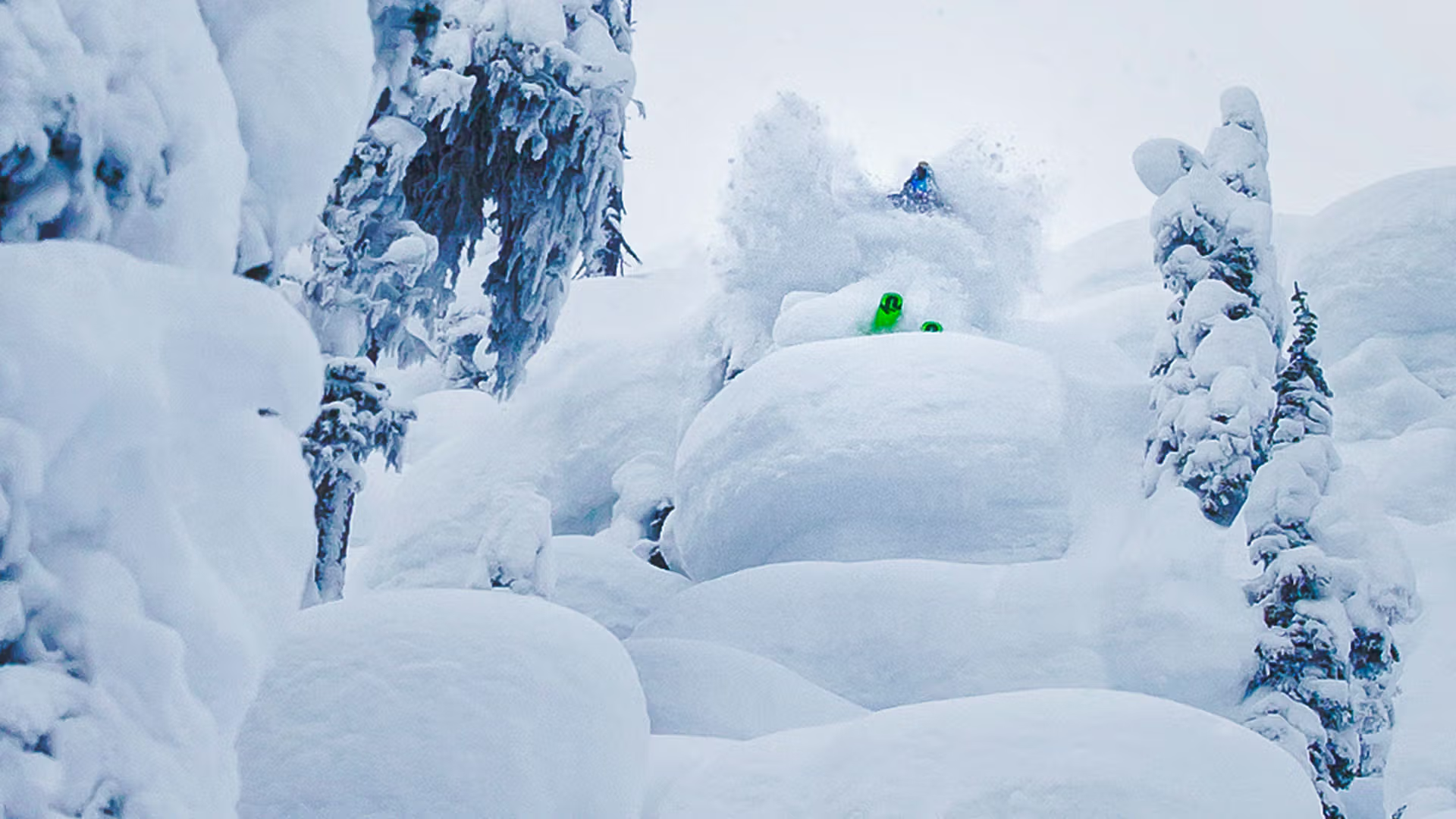
In an environment like this, powder doesn’t just make riding easier—it directly unlocks lines that otherwise can’t be ridden sustainably, letting you keep flow, rhythm, and a safety margin in high-intensity terrain.
Next most valuable: powder in steep, treed terrain. The powder provides speed control and forgiveness, while also demanding precise line choice and rhythm control—an excellent balance of skill and thrill.
Below that are open bowls with some pitch. This terrain isn’t inherently complex, but in powder you can “farm the slope” repeatedly, chasing smooth, surfy, rhythmic “low-altitude flight”—a low-risk, high-joy option.
The least valuable powder is:
- An open slope that’s too flat, where you can only straight-line
- And tight trees where you can’t form continuous, flowing turns
The former lacks gravity drive, so even the best snow becomes nothing more than straight-line crushing; the latter often turns powder riding into a fragmented experience of “brake between trees—restart—brake again,” where the cost far outweighs the return, and you might even drop into holes and depressions that leave snowboarders stuck in a “pulling radishes” nightmare.
Of course, this judgment is more about ride quality than about training value or what you may need at a given stage. For beginners, the first experience of straight-lining on untouched open powder can be joyful enough to savor for a long time.
One last point that’s easy to misunderstand: while there’s little need to ride too much bad snow, riding moguls on a snowboard really is a required course for smooth powder freeride. It has irreplaceable training value for lower-body absorption, rhythm control, and managing your center of mass. This isn’t denying its importance—the issue is about timing:
Once you already have enough ability, do you still want to keep spending your limited ski days, energy, and knee cartilage on bad snow? That’s a choice, not an obligation to “prove your love.”
Closing
“Riding only the snow that’s worth it” isn’t being picky, and it isn’t dodging difficulty. It’s more like a long-term protection mechanism for your stoke—within the limits of your body, energy, and the season, you leave your best lines on the snow and terrain that are truly worth remembering.
After all, we ride because, in some moment, on this day, in this place, we want to come away with a beautiful memory that won’t fade for the rest of our lives.