There are an enormous number of Earth-like planets in the universe. By probability, advanced civilizations should not be rare, yet we have not observed any traces of extraterrestrial civilizations. Physicist Fermi first raised this question, which became the famous Fermi paradox.
The “Great Filter” is one explanation for this paradox: along the evolutionary path from lifelessness to an advanced interstellar civilization, there may be one or more extremely difficult bottlenecks, causing the vast majority of civilizations to stagnate or disappear before reaching an observable stage.
Lately, I have increasingly felt that within snowboarding as a sport, there is also a “Great Filter” of a similar nature—one that is rarely discussed seriously.
Many people understand the threshold for snowboarding as money, time, or orthopedic risk. These factors certainly exist, but they are more like surface conditions for entering the “Great Filter” system. What truly determines whether someone can stay for the long term is whether, through sustained investment, they can continually draw enough enjoyment from snowboarding to keep moving forward, thereby forming a stable positive feedback loop. If each day on snow is defined mainly by cold fatigue, high costs, and obvious technical stagnation, while improvements in enjoyment come unusually slowly, then being gradually filtered out is almost an expected outcome.
As a freeride blogger, my source of snowboarding happiness is very singular: it comes almost entirely from powder. That state of high-speed floating, close to flying just above the ground, forces intense concentration; the sense of time compresses into the present instant. The dopamine intensity it brings exceeds most everyday experiences, almost comparable to real “cocaine” addiction. I can hardly imagine what kind of entertainment in daily life could replace it over the long term.
But interestingly, in various settings I also often hear people say:
“I’m actually not that interested in powder. I don’t think riding powder is that fun.”
Every time I hear this, a question pops up in my mind, but out of politeness I usually swallow it back:
If you had Travis Rice’s skill level and I took you to ride those extreme powder lines from his films, would you really still be uninterested?
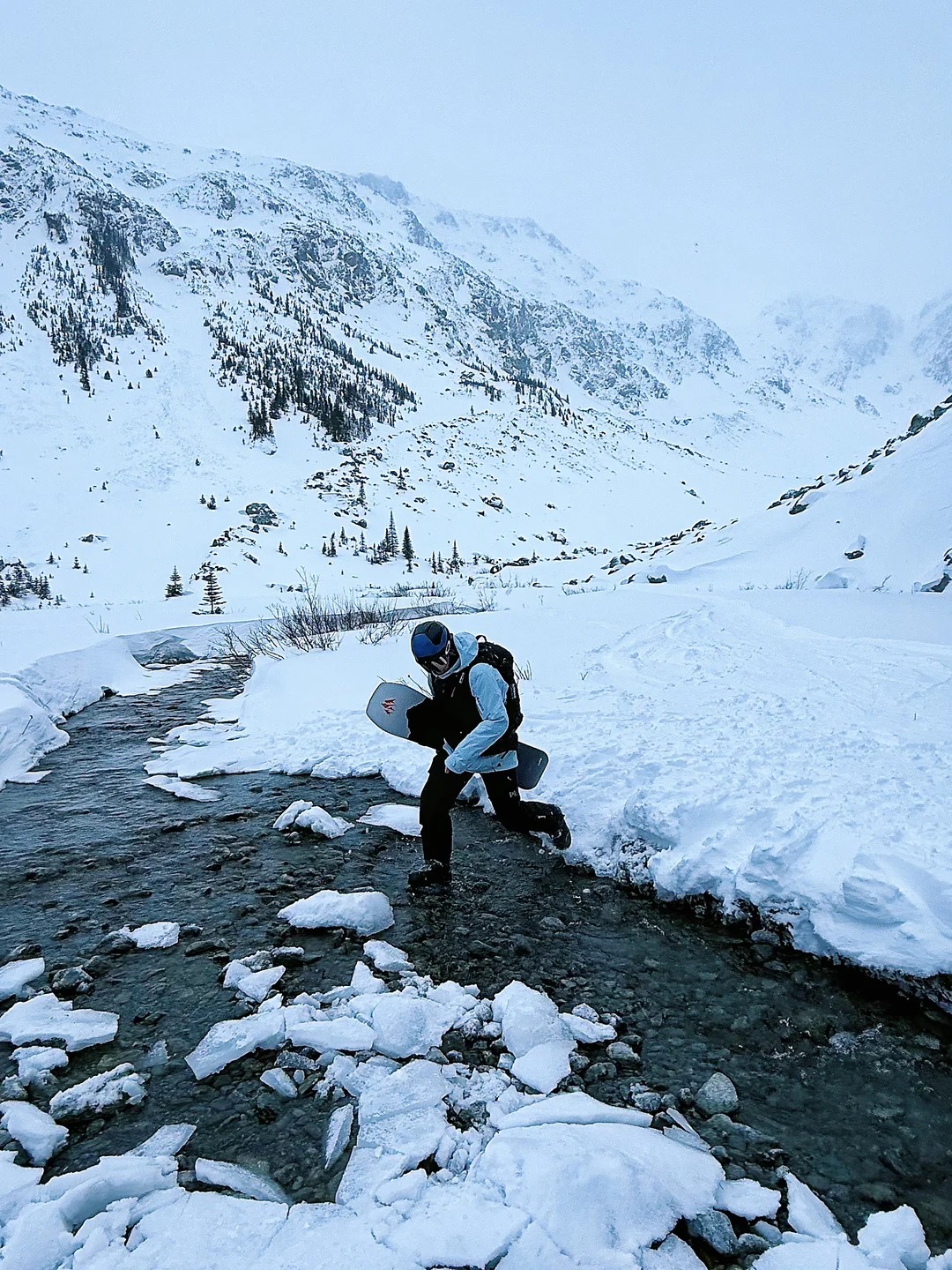
This phenomenon has pushed me to think about what “not chasing powder” really means—often, it is more like one’s ability has not yet entered powder’s effective enjoyment range. Whether 🏂 or ⛷️, riding off-piste powder when your technique does not match often means higher physical expenditure, more fragile control, more frequent falls, and the amplified uncertainty and fear that come with them. In that state, it is naturally difficult to find joy.
And advanced off-piste snowboarding demands even more stringent technique, especially being extremely unforgiving for snowboarding: managing center of mass and rhythm; controlling board flex and turning efficiently; memorizing and reading terrain; and maintaining all-around awareness in complex environments. A weakness in any link directly undermines the experience, and can even trap you in the nightmare of “pulling turnips.” This is why snowboarding’s Great Filter often appears at the intermediate-to-advanced stage: technical progress begins to slow, the cost of falling gradually rises, and the learning curve steepens further. If, at this point, there is a lack of sufficiently clear goals, the input-output ratio deteriorates rapidly.
Powder can, to some extent, break through this filter in reverse, because at an earlier stage it already gives some people sufficiently strong positive feedback. Many people first truly feel the charm of snowboarding not by completing advanced short turns in complex bump terrain, but by accidentally experiencing, on a simple wide open slope, a fleeting “flying feeling” brought by speed and flotation. That experience alone is enough to form a clear and concrete interest anchor early on. As investment deepens, when technique, physical adaptation, and terrain reading gradually align, the corresponding experience is amplified and reconstructed, ultimately showing a qualitative change in off-piste environments—sometimes even making it hard to adapt to life without snow.
However, even after crossing the technical threshold, the snowboarding Great Filter continues to select. Take the pursuit of powder as an example: it is a highly scarce natural resource, constrained by weather systems, geography, resort management strategies, and brief time windows. This means that higher skill does not guarantee a stable supply of dopamine returns—skill is more like an entry permit, but it cannot promise deliverable availability. Long-distance travel, hiking for vert, expensive transport and lodging or even 🚁 costs, and more hidden decision and information costs (such as avalanche risk) keep raising the bar.
For many people, it is not that their passion fades, but that it is hard to keep paying such a high price for experiences with uncertain outcomes over the long term. As people age, declining recovery capacity gradually becomes apparent; the per-unit joy of powder does not increase, but the cost paid does. This shift quietly reshapes the relationship between returns and expenditures, turning powder from an entertainment need into something closer to a luxury good. At this stage, the Great Filter takes on a chained structure, with factors on all sides compressing snowboarding’s return curve.
Therefore, there are indeed many skiers and riders who have mature off-piste ability, yet gradually lose time freedom, geographic advantage, lifestyle flexibility, or physical capacity. Skiing in their lives shifts from a sustainable happiness-production system to an occasional, high-cost consumption. Against this backdrop, “no longer being obsessed with powder” is merely a rational adjustment under real constraints—some shift their interest toward more stable groomers, honing turn shape, speed, and style; others choose sports with more controllable feedback, such as 🎾 and ⛳️
Overall, after life crosses certain stages, one has to recalculate the cost and rate of return of obtaining happiness, and snowboarding is just one path among them. Powder is precious not only because of the intense experience it brings, but because it lets you see clearly: anything beautiful worth pursuing cannot be owned steadily; it can only be cashed in briefly, at moments when the conditions happen to align.